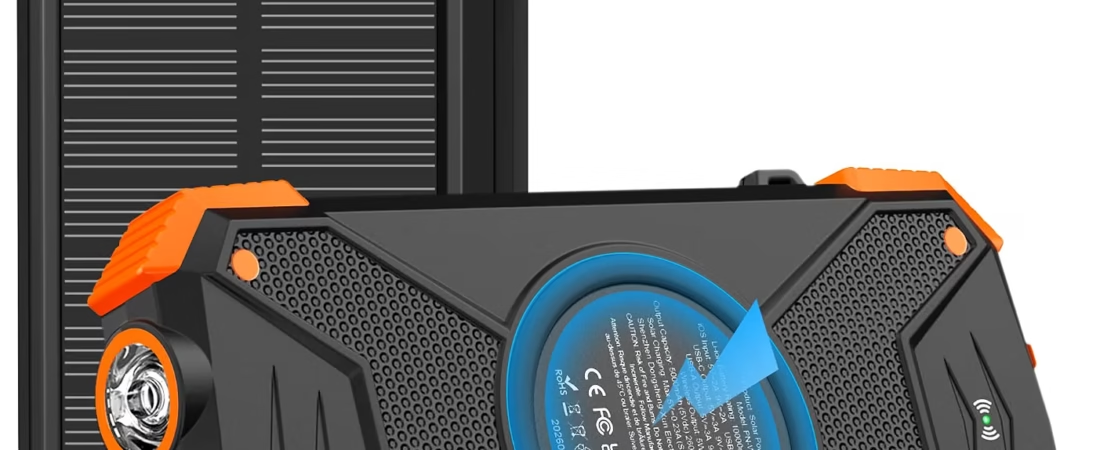
Staying connected while away from a wall outlet can be difficult when traveling, hiking, camping, commuting, or spending a long day outdoors. Smartphones have become useful tools for navigation, communication, photography, entertainment, and emergency contact, but all of those functions depend on battery power. A portable power bank can provide an additional source of energy when access to conventional charging is limited.
The BLAVOR Solar Power Bank 10,000mAh Portable Wireless Charger for Cell Phones is designed around that idea. Rather than functioning solely as a conventional battery pack, it combines portable battery storage with wireless charging, solar charging capability, and built-in lighting features. Its design is particularly relevant to people who spend time outdoors or want an additional charging option for situations where access to electrical outlets is inconvenient.
A solar power bank should not be thought of as a replacement for a regular wall charger. Solar charging is affected by sunlight intensity, positioning, weather, temperature, and the size of the solar panel. Instead, it can be considered an additional charging method that may provide useful supplemental energy over time.
The 10,000mAh capacity also places this device in a practical middle ground. It is substantially more capable than relying only on a smartphone battery, while remaining portable enough to carry in a backpack, travel bag, or emergency kit.
This guide explains how the BLAVOR solar power bank works, what its major features mean in everyday use, where it can be useful, and what to consider before choosing a portable power bank with solar and wireless charging capabilities.
Understanding the BLAVOR 10,000mAh Solar Power Bank
A portable power bank essentially stores electrical energy inside an internal battery so that compatible devices can be charged later. Instead of needing to remain connected to an outlet, the power bank can be charged beforehand and carried wherever additional power may be needed.
The BLAVOR model discussed here adds several functions to that basic concept.
Its stated 10,000mAh battery capacity provides a portable energy reserve for compatible mobile devices. It also supports wireless charging, meaning compatible smartphones can potentially receive power without requiring a charging cable. For wired charging, the power bank includes physical charging connections.
Another distinguishing feature is solar charging. The integrated solar panel can convert sunlight into electrical energy that contributes to recharging the internal battery. The amount of energy generated depends heavily on environmental conditions, however, so solar charging should generally be viewed as a supplemental feature rather than an instant replacement for conventional charging.
The device also incorporates a flashlight, which can be useful when navigating dark areas, locating items inside a tent, or keeping an additional light source in an emergency kit.
These features make the power bank more than simply a battery pack. It is a compact combination of energy storage, charging functionality, and basic illumination intended for portable use.
Key Features
10,000mAh Battery Capacity
The 10,000mAh capacity refers to the approximate charge capacity of the power bank’s internal battery.
In practical terms, the amount of usable energy delivered to a smartphone will not be identical to the advertised battery capacity. Energy is lost during voltage conversion, charging, heat generation, and other parts of the charging process.
The actual number of phone charges therefore depends on factors such as:
- The smartphone’s battery capacity
- Charging efficiency
- The phone’s charging requirements
- Whether the phone is being used during charging
- Cable and connection losses
- Battery condition
- Temperature
For example, a phone with a relatively small battery may receive more charging cycles from a 10,000mAh power bank than a phone with a much larger battery.
This makes capacity an important specification, but it should not be interpreted as a guarantee of a particular number of complete smartphone charges.
Solar Charging Capability
The solar panel is one of the most distinctive aspects of this power bank.
Solar charging allows the internal battery to receive energy from sunlight. This can be useful during outdoor activities where electrical outlets are unavailable.
However, solar charging is fundamentally different from plugging the power bank into a wall charger.
A compact portable solar panel has limited surface area. The amount of energy it can collect at any moment depends on factors such as direct sunlight, cloud cover, panel orientation, shade, season, and environmental conditions.
A power bank may therefore take considerably longer to recharge through its integrated solar panel than through a conventional electrical charging source.
This distinction is important when planning an outdoor trip. A practical approach is to fully charge the power bank before leaving and treat solar charging as an additional source of energy during the trip.
Wireless Charging
Wireless charging can reduce the need to carry a charging cable for compatible smartphones.
Instead of physically connecting the phone to a charging port, the compatible device can be positioned over the wireless charging area of the power bank.
Wireless charging is convenient, but it has limitations. Compatibility depends on the phone’s wireless charging standard and hardware. Protective cases, alignment, and other physical factors can also affect charging performance.
Wireless charging can also produce more heat than some wired charging configurations. For this reason, users should follow the instructions for both the power bank and their smartphone and avoid covering either device with materials that could unnecessarily trap heat.
Built-In Flashlight
The integrated flashlight adds another practical function.
A flashlight can be useful in situations that do not necessarily involve charging a phone. For example, it can help with:
- Walking around a campsite after dark
- Finding equipment in a backpack
- Locating a charging cable
- Checking an unfamiliar area
- Reading a map at night
- Emergency preparedness
- Navigating during a power outage
Having the light integrated into the power bank means one compact device can serve multiple purposes.
Portable Design
Portability is central to the concept of a power bank.
A 10,000mAh unit can be carried in a backpack, travel bag, or emergency kit without requiring a separate power source while in transit.
For outdoor users, portability can be particularly important because every additional item adds weight and occupies space. Combining a battery, wireless charging capability, solar charging function, and flashlight into one device can simplify what needs to be packed.
How It Can Be Used
Everyday Smartphone Charging
One of the simplest uses is providing additional battery power during a normal day.
Someone may leave home in the morning with a fully charged smartphone but spend several hours away from an outlet. Navigation, messaging, mobile data, photography, and other activities can gradually reduce the phone’s battery level.
A portable power bank can provide additional charging without requiring the user to find a wall socket.
This can be especially useful during long commutes, conferences, festivals, sightseeing trips, or days spent traveling between locations.
Camping and Hiking
Outdoor recreation is one of the situations where a portable solar power bank can make particular sense.
During a camping trip, access to electrical outlets may be limited or nonexistent. A power bank can provide a way to maintain essential electronics without relying entirely on campsite infrastructure.
The flashlight can also provide a convenient source of illumination.
For hiking, the power bank can be stored in a backpack and used when a phone needs additional energy for navigation or communication.
It is still important to manage battery consumption carefully. Solar charging should not be treated as an unlimited source of electricity.
Road Trips
Long-distance travel often involves extended periods away from convenient charging locations.
A power bank can provide an independent charging option for a smartphone, especially when passengers need to keep their devices available during the journey.
It can also be useful when stopping at locations where electrical outlets are unavailable or occupied.
Travel and Sightseeing
Travelers often rely heavily on smartphones for maps, boarding information, translation tools, photographs, reservations, communication, and transportation information.
A depleted phone battery can therefore become more than a minor inconvenience.
Carrying a portable power bank gives travelers another option for maintaining their phone’s battery during a busy day.
The wireless charging function can also reduce cable dependence when the smartphone is compatible.
Emergency Preparedness
A power bank can be included in a household emergency kit.
During a temporary power outage, smartphones may become important communication tools. Having a charged power bank available can extend the amount of time a phone remains operational.
The flashlight adds another useful function for emergency situations, particularly when normal lighting is unavailable.
For emergency preparation, it is worth periodically checking the power bank’s charge level rather than assuming it will remain fully charged indefinitely.
Outdoor Photography
Smartphone photography can consume significant battery power, especially when using cameras, GPS, mobile data, high screen brightness, and video recording.
A portable power bank can help extend the usable time of a phone during outdoor photography sessions.
This can be useful for travelers, hikers, event attendees, and anyone who expects to spend long periods taking photos or recording video.
Who It May Be Suitable For
Outdoor Enthusiasts
People who regularly go camping, hiking, fishing, or on other outdoor trips may appreciate having multiple portable functions in one device.
The combination of stored battery power, solar charging, wireless charging, and illumination can reduce the number of separate accessories needed.
Travelers
Frequent travelers may find a portable power bank useful for long days away from hotel rooms, airports, train stations, or other charging locations.
The device can be charged before leaving and carried as an additional energy source.
Emergency Kits
Households that maintain emergency supplies may consider including a portable power bank alongside flashlights, batteries, first-aid supplies, and other preparedness items.
The built-in light provides an additional reason to keep the device accessible rather than treating it solely as a phone accessory.
Students and Commuters
Students and commuters can spend many hours away from home. A portable battery can provide extra flexibility when a phone battery begins running low during the day.
People Who Prefer Wireless Charging
For users with compatible smartphones, wireless charging can make short charging sessions more convenient by reducing the need to connect a cable directly to the phone.
Important Things to Consider
Solar Charging Is Weather Dependent
One of the most important considerations is understanding what the integrated solar panel can realistically do.
Solar panels need sufficient light to generate energy. Cloudy conditions, shade, indoor environments, poor panel orientation, and limited daylight can all reduce energy production.
The relatively small solar panel integrated into a portable power bank also has a much smaller collection area than a dedicated solar panel.
For this reason, it is sensible to regard the solar function as supplementary.
Before a trip, charge the power bank using its conventional charging method. Solar charging can then provide an additional option while outdoors.
10,000mAh Does Not Equal 10,000mAh Delivered to a Phone
Battery capacity specifications describe the internal battery under specified measurement conditions.
Charging a smartphone involves electrical conversion between different voltage levels, and energy is lost during this process.
Consequently, users should not expect a 10,000mAh power bank to deliver a literal 10,000mAh of usable capacity directly to the phone.
The real-world result will depend on the phone and charging method.
Wireless Charging Requires Compatibility
Not every smartphone supports wireless charging.
Before relying on the wireless function, check whether the specific phone model supports the required wireless charging standard.
Even compatible phones can behave differently depending on their case, alignment, software, temperature, and battery-management system.
A wired connection may be more appropriate when a faster or more consistent charging experience is required.
Outdoor Exposure Still Requires Care
A product marketed for outdoor use should not automatically be interpreted as indestructible.
Water resistance or splash resistance, where applicable, does not necessarily mean the device can be submerged or exposed to every type of weather without risk.
Users should follow the manufacturer’s instructions concerning water, dust, temperature, drops, and storage.
Avoid using damaged charging cables, damaged ports, or visibly damaged battery equipment.
Battery Storage and Maintenance
Lithium-based batteries gradually lose charge capacity over time.
Storage conditions can influence battery longevity. Extreme heat should generally be avoided, particularly inside closed vehicles exposed to strong sunlight.
For occasional emergency use, periodically check the power bank and recharge it when necessary.
Keeping the device accessible is also important. An emergency power bank that is buried at the bottom of an inaccessible storage container may be difficult to use when needed.
Charging Multiple Devices
Portable power banks are often used with more than one device, but the available energy is finite.
If several devices are connected at once, the stored energy will be distributed among them. This means the total available charging time for each device may be reduced.
Users should prioritize essential devices during situations where power is limited.
Solar Power Bank vs. Conventional Power Bank
A conventional power bank primarily focuses on storing electricity and delivering it to another device.
A solar power bank adds the possibility of generating supplemental energy from sunlight.
The main difference is therefore the charging flexibility.
A conventional model may be simpler for users who primarily charge the power bank at home and use it during commuting or travel.
A solar-equipped model can provide another option when spending time outdoors.
The trade-off is that integrated solar panels have limited surface area and are affected by environmental conditions. For everyday indoor use, the solar feature may have little practical relevance.
Solar Power Bank vs. Dedicated Portable Solar Panel
A dedicated portable solar panel generally has a larger surface area and can therefore collect more sunlight than the small panel integrated into a power bank.
This can make dedicated panels more appropriate for extended outdoor trips where solar generation is a major part of the energy strategy.
An integrated solar power bank, on the other hand, is more compact and combines energy storage and solar collection in one device.
The appropriate category depends on the intended use.
For short trips and emergency preparedness, an integrated solution can reduce the amount of equipment being carried. For longer off-grid applications, a larger dedicated solar setup may provide more practical solar-generation capacity.
Solar Power Bank vs. Wireless Charging Battery Pack
A wireless battery pack focuses primarily on convenient charging for compatible smartphones.
The BLAVOR design adds solar charging and lighting to that basic concept.
For someone who rarely spends time outdoors, these additional functions may not be particularly important.
For camping, hiking, travel, or emergency preparedness, however, having multiple functions in one portable device can be useful.
The choice ultimately depends on which features match the user’s normal activities.
Solar Power Bank vs. Wall Charger
A wall charger and power bank serve different purposes.
A wall charger requires access to an electrical outlet but can be used to recharge a device directly.
A power bank stores energy beforehand and allows that energy to be carried elsewhere.
Many people can benefit from having both. A wall charger can replenish the power bank when an outlet is available, while the power bank can be used when an outlet is not convenient.
This makes a portable battery more of a complement to conventional charging rather than a complete replacement.
Practical Tips for Getting More From a Portable Power Bank
Start with a full charge before leaving home. This gives you the largest available energy reserve at the beginning of a trip.
If using solar charging, position the solar panel toward direct sunlight whenever practical. Avoid shade and check the device periodically rather than assuming that placing it somewhere outdoors will automatically produce substantial charging.
Reduce unnecessary smartphone battery consumption when power is limited. Lowering screen brightness, disabling unused wireless connections, and limiting demanding applications can extend the phone’s operating time.
Use wireless charging when convenience is the priority and a wired connection when the specific situation calls for it.
Keep cables organized so that the power bank remains easy to use while traveling.
Finally, store the device somewhere dry and away from excessive heat when it is not being used.
Frequently Asked Questions
Can the BLAVOR 10,000mAh power bank charge a smartphone wirelessly?
It is designed with wireless charging functionality for compatible devices. Actual compatibility depends on the smartphone and its supported wireless charging technology.
Can it recharge itself using sunlight?
Yes, the device incorporates solar charging capability. However, solar charging performance depends on sunlight and environmental conditions, and the compact integrated panel should generally be considered a supplemental charging source.
How many times can a 10,000mAh power bank charge a phone?
There is no universal number because smartphone battery capacities and charging efficiencies vary. Energy losses during conversion also mean that the usable output is lower than the nominal internal battery capacity.
Is solar charging fast?
Solar charging from a compact integrated panel is generally much slower and more variable than charging the power bank from a conventional electrical source. Sunlight intensity, panel positioning, cloud cover, and other conditions influence the charging rate.
Can the power bank be used while camping?
Its portable battery, solar charging capability, wireless charging function, and flashlight make this type of device suitable for many camping scenarios. Users should still protect it from conditions beyond its stated environmental limits.
Does every phone support wireless charging?
No. Wireless charging depends on the hardware and charging standard supported by the phone. Check the specifications of the specific smartphone before relying on wireless charging.
Can it replace a regular phone charger?
Not completely. A power bank stores energy and provides portable charging, while a regular charger typically connects to an electrical outlet. The two serve different purposes and can be used together.
Is a 10,000mAh power bank enough for travel?
For many short trips and everyday situations, 10,000mAh provides a useful amount of portable battery capacity. Whether it is sufficient depends on the number of devices being charged, their battery sizes, and how heavily they are used.
Is the built-in flashlight useful outside of emergencies?
Yes. A flashlight can be useful for ordinary outdoor activities such as finding equipment at night, walking around a campsite, locating items inside a bag, or navigating poorly lit areas.
What should I do before taking it on a trip?
Charge the power bank fully using its normal charging method, verify that your phone is compatible with the charging functions you intend to use, pack the necessary cables if using wired charging, and check the device for visible damage.
Final Thoughts
The BLAVOR Solar Power Bank 10,000mAh combines several portable functions in a single device: stored battery power, wireless charging, solar charging capability, and a built-in flashlight. These features can be particularly relevant when access to electrical outlets is limited, whether during travel, camping, hiking, commuting, or emergency situations.
The most important point to understand is the role of the solar panel. Solar charging can provide useful supplemental energy, but it is dependent on sunlight and the limitations of a compact integrated panel. Fully charging the power bank through a conventional source before leaving home remains a sensible approach.
The 10,000mAh capacity also provides a portable energy reserve, although actual charging results vary depending on the smartphone, charging method, efficiency, and usage conditions. Wireless charging adds convenience for compatible devices, while the flashlight gives the power bank a practical function beyond charging electronics.
Ultimately, the value of a multi-function power bank depends on how its features fit into your routine. Someone who primarily works near electrical outlets may use only the battery function occasionally, while travelers and outdoor users may find the combination of portable power, solar charging, wireless charging, and lighting more relevant.
If you are considering this type of portable charger, paying attention to capacity, charging compatibility, solar limitations, environmental conditions, and your intended use can help you understand whether the format fits your needs.