A dependable flashlight can be useful in far more situations than an emergency power outage. It can help illuminate a hiking trail after sunset, make it easier to find equipment inside a tent, provide additional light during a roadside problem, or simply help locate something in a dark storage area. Because modern LED flashlights can be compact while producing substantial illumination, they have become a common part of household, vehicle, camping, and outdoor gear.
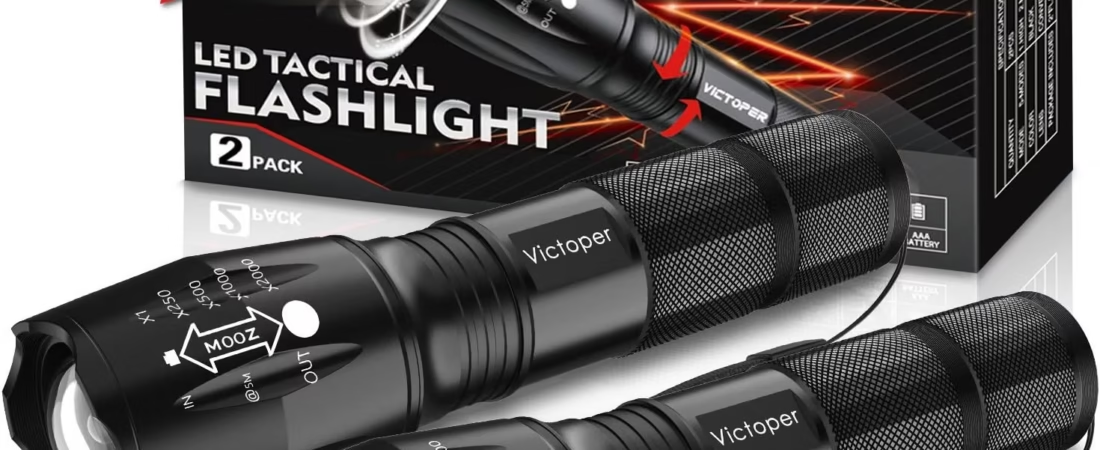
The Victoper LED Flashlight 2 Pack is designed as a pair of portable LED flashlights featuring multiple lighting modes, adjustable beam focus, and a construction intended for outdoor use. Having two flashlights in one set can also be practical for households, couples, travel groups, or people who prefer to keep separate lights in different locations.
The product listing describes the flashlights as high-lumen tactical-style torches with five lighting modes, waterproof construction, and a zoomable beam. These features address several common requirements of portable lighting: controlling brightness, adjusting the beam, carrying a light outdoors, and having a backup unit available.
At the same time, flashlight specifications should always be interpreted in context. A lumen figure describes the amount of visible light produced under specified conditions, but it does not by itself determine how far a beam will reach, how useful it will be for a particular task, or how long the flashlight will operate. Battery condition, beam configuration, environment, and usage mode all influence real-world performance.
This guide explains the main features of the Victoper two-pack, how adjustable LED flashlights work, where they may be useful, what to consider before relying on one outdoors, and how this type of flashlight compares with other common lighting categories.
Understanding the Victoper LED Flashlight 2 Pack
The basic concept is straightforward: the set provides two portable LED flashlights that can be used independently.
A flashlight typically consists of an LED light source, reflector or optical system, power source, housing, switch, and other supporting components. The optical system determines how light is distributed in front of the flashlight.
The Victoper design adds multiple lighting modes and an adjustable beam mechanism.
Multiple modes can make a flashlight more flexible. A lower-output mode can be useful when only nearby illumination is required, while a stronger setting may be more appropriate for looking farther ahead.
A zoomable mechanism can also change the shape or concentration of the beam.
The two-flashlight configuration adds another practical advantage: redundancy.
One flashlight can stay in a vehicle while the other remains in a backpack. Alternatively, two people can carry one each during an evening outdoor activity.
Key Features
Two Flashlights in One Set
The two-pack format gives users two independent lights.
This can be helpful in situations where more than one person needs illumination or where a backup flashlight is useful.
For example, a household might keep one flashlight near the entrance and another with emergency supplies. A camper might keep one inside the tent and another in a daypack.
Having multiple lights can also reduce the temptation to rely on a smartphone flashlight when a dedicated light would be more practical.
LED Light Source
LED technology is widely used in portable flashlights because LEDs can produce substantial illumination from a relatively compact light source.
Compared with older incandescent flashlight designs, LED systems can offer advantages in efficiency, durability, and physical size.
The actual brightness available from a flashlight depends on its design, power source, thermal management, optics, and operating mode.
This is why looking at the overall flashlight design is more informative than focusing only on a single brightness number.
Five Lighting Modes
The product is described as having five lighting modes.
Multiple modes allow the user to adjust the flashlight according to the situation rather than operating at one fixed output level.
Different modes may be useful for different purposes, such as:
- Nearby reading
- Walking
- General campsite illumination
- Searching an outdoor area
- Emergency visibility
Using a lower-output mode when maximum brightness is unnecessary can also help conserve battery power.
The exact behavior of the five modes should be checked against the current product instructions because mode configurations can vary between flashlight models.
Zoomable Beam
The zoom function allows the flashlight’s optical configuration to be adjusted.
A wider beam can illuminate a broader area nearby, while a more concentrated beam can direct more light toward a smaller area farther ahead.
This can be useful because different situations require different beam patterns.
For example, walking around a campsite generally benefits from broader illumination. Looking toward a distant trail marker may benefit from a more concentrated beam.
A zoomable flashlight therefore provides greater control over how its light is distributed.
Waterproof Construction
The product is marketed as waterproof and intended for outdoor use.
Water resistance can be valuable when a flashlight is used during rain, near water, or in damp outdoor environments.
However, terms such as waterproof should always be interpreted according to the product’s actual specifications and intended rating.
Water resistance does not necessarily mean the flashlight is suitable for prolonged submersion, high-pressure water exposure, or every aquatic environment.
Users should follow the manufacturer’s instructions regarding water exposure and battery compartment sealing.
Compact Outdoor Format
The flashlight is designed to be portable enough for activities such as hiking and camping.
A compact flashlight can be carried in a backpack, pocket, vehicle compartment, emergency kit, or outdoor gear bag.
The two-pack makes it possible to keep one light in a frequently used location while storing the second as a backup.
How It Can Be Used
Hiking After Dark
Hiking after sunset requires reliable illumination because uneven terrain, rocks, roots, and other obstacles can become difficult to see.
A handheld LED flashlight can provide a focused source of light without requiring a smartphone to remain active.
The beam can be adjusted depending on whether the hiker needs broad illumination immediately ahead or wants to inspect something farther away.
When hiking at night, it is still important to carry appropriate navigation equipment and avoid relying entirely on the flashlight for route finding.
Camping
A flashlight is one of the most practical pieces of camping equipment.
It can help with:
- Setting up camp after dark
- Finding equipment inside a tent
- Walking between campsite areas
- Checking surroundings
- Reading maps
- Organizing cooking equipment
- Finding footwear or other personal items
The multiple modes can be useful because campsite lighting requirements vary.
A lower setting may be adequate inside a tent, while a more focused beam may be useful when walking outside.
Emergency Power Outages
A dedicated flashlight can be more convenient than a smartphone during a prolonged power outage.
Using a phone as a flashlight consumes battery power that may be needed for calls, messages, navigation, or emergency information.
Keeping one or both Victoper flashlights in an accessible location can provide an independent lighting source.
For household emergency preparedness, it is sensible to keep spare batteries or the appropriate charging equipment available, depending on the flashlight’s power configuration.
Vehicle Emergency Equipment
A flashlight can be useful when dealing with an unexpected vehicle problem at night.
It can help illuminate the area around the vehicle, inspect a tire or engine compartment, locate equipment, or make it easier to see while waiting for assistance.
A flashlight should complement, rather than replace, vehicle-specific safety equipment such as warning devices and reflective materials.
When stopped on or near a roadway, personal safety and visibility should take priority.
Dorm Rooms
The product description specifically mentions dorm-room use.
A compact flashlight can be useful for finding items in a dark room, navigating a hallway during an outage, or keeping a backup light in a student emergency kit.
The two-pack can also be divided between roommates or different areas.
Home Maintenance
Dark spaces under furniture, behind appliances, inside storage areas, or around outdoor structures can be difficult to inspect with ordinary room lighting.
A handheld flashlight allows light to be directed exactly where it is needed.
This can make simple maintenance tasks more convenient.
Outdoor Events
A portable flashlight can also be useful at outdoor events, evening gatherings, festivals, and recreational activities.
A compact handheld light can help with navigation between locations or finding personal belongings after dark.
Emergency Preparedness Kits
A flashlight is a fundamental component of many emergency kits.
Power outages, storms, equipment failures, and other unexpected events can temporarily eliminate normal lighting.
Keeping two flashlights available provides redundancy. If one is misplaced or its battery is depleted, the second can still be available.
Understanding Lumens
The term lumens describes the total amount of visible light emitted by a light source.
It is useful, but it should not be treated as the only measure of flashlight performance.
Two flashlights with similar lumen ratings can produce noticeably different experiences because their optical systems may distribute light differently.
A flashlight with a broad beam can illuminate a large nearby area.
A flashlight with a narrower beam can concentrate light into a smaller area and potentially provide greater beam distance.
The housing, reflector, lens, LED, power supply, and thermal management all contribute to the final result.
This is why the Victoper’s adjustable beam is relevant alongside its advertised brightness.
Understanding Beam Distance
Beam distance refers to how far the flashlight’s illumination reaches under defined testing conditions.
A longer beam does not necessarily mean the flashlight is better for every purpose.
For close-range tasks, a very concentrated beam can actually be less convenient because it illuminates a smaller area.
For walking on a trail, a balanced beam may make it easier to identify obstacles across the path.
For inspecting a distant object, a concentrated beam may be more useful.
The ability to adjust the beam can therefore provide flexibility between these situations.
Who It May Be Suitable For
Hikers
People who hike in the early morning, evening, or after sunset can use a handheld flashlight as part of their outdoor lighting equipment.
Campers
Camping often requires portable illumination, particularly when setting up or moving around after dark.
Vehicle Owners
A flashlight can be included in a roadside emergency kit for situations that occur after sunset.
Students
Students living in dormitories or shared accommodation can keep a flashlight available for outages and everyday needs.
Homeowners and Renters
A flashlight can be useful for maintenance, storage areas, power outages, and general household tasks.
Outdoor Enthusiasts
People involved in fishing, hunting where lawful, hiking, camping, travel, or other evening outdoor activities may have regular reasons to carry portable lighting.
Families
Two flashlights can provide useful redundancy within a household. Separate units can be stored in different rooms or assigned to different family members.
Important Things to Consider
Battery Type and Availability
Before relying on any flashlight for emergencies, determine how it is powered.
Users should know whether the particular configuration requires disposable batteries, rechargeable cells, or another power source.
Keep the necessary batteries or charging equipment available.
If the flashlight is intended for emergency storage, periodically inspect the batteries as well as the flashlight itself.
Brightness and Battery Life Are Connected
Higher-output lighting generally places greater demands on the power source.
Using maximum brightness continuously may reduce operating time compared with a lower setting.
This is one reason multiple lighting modes are useful.
There is little benefit in using the highest output when a lower setting provides sufficient illumination.
Waterproof Does Not Mean Indestructible
Even an outdoor-oriented flashlight should be treated as electronic equipment.
Avoid unnecessary drops, extreme temperatures, chemical exposure, and conditions beyond its stated specifications.
If the flashlight has a battery compartment, ensure seals and covers are properly positioned before exposure to moisture.
Heat Management
High-output LEDs can generate heat.
The flashlight housing may become warm during prolonged use at higher settings.
Avoid covering ventilation areas or placing a running flashlight against materials that could trap heat.
Do not leave a high-output flashlight operating unattended for extended periods.
Zoom Mechanism
The zoom function is a mechanical feature, so it should be operated carefully.
Do not force the mechanism if it becomes resistant.
Dirt, sand, or other debris can potentially affect moving components when a flashlight is used outdoors.
Keeping the flashlight reasonably clean can help maintain smooth operation.
Carrying Two Flashlights
A two-pack provides redundancy, but both units should be maintained.
There is little benefit to storing the second flashlight for an emergency if its batteries are depleted or the unit has been damaged during storage.
Periodically test both lights.
Night Vision
Very bright light is not always desirable.
When walking with other people or using a flashlight in a campsite, excessive brightness can interfere with others’ vision.
A lower setting or broader beam may be more appropriate in close quarters.
Bright light can also temporarily reduce a person’s ability to see in darkness after the flashlight is switched off.
Flashlight Safety
Flashlights are generally simple devices, but several precautions are worthwhile.
Never shine a high-output flashlight directly into someone’s eyes.
Do not use the beam to distract drivers or cyclists.
Keep batteries installed according to the correct polarity.
Remove disposable batteries during long-term storage if recommended by the manufacturer and if leakage could become a concern.
Do not use damaged batteries.
If a battery becomes swollen, leaks, becomes unusually hot, or shows other signs of damage, discontinue use and follow appropriate battery-disposal guidance.
Keep small batteries away from children because swallowed batteries can cause serious injury.
Flashlight vs. Smartphone Light
A smartphone includes a convenient flashlight function, so it can be useful as a backup.
However, a dedicated flashlight has several practical differences.
A separate flashlight does not consume the phone’s main battery.
It can generally be held in a more ergonomic position for extended outdoor use.
It can also be stored permanently in a vehicle, backpack, or emergency kit rather than requiring the phone to be available.
For emergency preparedness, a dedicated flashlight therefore provides useful redundancy.
A smartphone remains valuable as a communication and navigation device, but using it exclusively as an emergency light may unnecessarily consume its battery.
Flashlight vs. Headlamp
A headlamp is worn on the head and leaves both hands available.
This can be particularly useful for setting up a tent, climbing, repairing equipment, or walking while carrying objects.
A handheld flashlight provides more control over where the beam is directed because it can be aimed independently of the user’s head.
The two categories are therefore suited to different activities.
Some campers carry both: a headlamp for hands-free tasks and a handheld flashlight for general searching or longer-distance illumination.
Flashlight vs. Lantern
A lantern is generally designed to illuminate an area rather than project a directional beam.
It can be useful inside a tent, room, or campsite.
A flashlight is more appropriate when the user needs to illuminate a specific direction.
For emergency preparedness, both can be useful.
A lantern can provide general area lighting, while a flashlight can help with movement and inspection.
Flashlight vs. Tactical-Style Flashlight
The term “tactical” is often used to describe flashlight shapes and designs associated with rugged outdoor or professional-style use.
The label itself does not automatically define brightness, durability, beam distance, or suitability for a particular task.
When evaluating a tactical-style flashlight, focus on concrete characteristics such as battery system, modes, beam pattern, water resistance, physical dimensions, construction, and intended use.
The Victoper model’s practical features—multiple modes, adjustable beam, portable construction, and outdoor-oriented design—are more meaningful than the word “tactical” by itself.
Creating a Practical Outdoor Lighting Kit
A flashlight becomes more useful when included in a broader lighting plan.
For a camping trip, consider carrying:
- A primary flashlight
- A second flashlight or backup light
- A headlamp
- Spare batteries or charging equipment
- A lantern for area lighting
- Appropriate navigation equipment
The exact combination depends on the trip.
For a short campground stay near a vehicle, a simple flashlight and lantern may be sufficient.
For remote hiking, redundancy becomes more important because replacement equipment may not be readily available.
Maintaining the Flashlights
A little routine maintenance can help keep portable lights ready.
Check the flashlight periodically rather than waiting for an emergency.
Inspect the housing for cracks or damage.
Test all available lighting modes.
Operate the zoom mechanism gently and confirm that it moves normally.
Check the battery compartment and contacts for signs of corrosion or leakage.
If the flashlight has seals intended to protect against moisture, make sure they remain properly seated.
Store the flashlights in a place where they are easy to find.
A flashlight hidden beneath unrelated equipment is not very useful during a power outage.
Frequently Asked Questions
How many flashlights are included?
The product is presented as a two-pack, providing two Victoper LED flashlights.
How many lighting modes does the flashlight have?
The product description identifies five lighting modes. The precise behavior of each mode should be confirmed using the current product instructions.
Is the Victoper flashlight suitable for hiking?
Its portable design, adjustable beam, multiple lighting modes, and outdoor-oriented construction make it suitable for many hiking situations. Users should still carry appropriate navigation and backup equipment for longer or more remote routes.
Can it be used while camping?
Yes. A handheld flashlight can be useful for setting up camp, navigating around a campsite, finding equipment, and handling other nighttime tasks.
What does a zoomable flashlight do?
A zoom mechanism changes how the flashlight’s beam is distributed. It can allow the user to move between broader nearby illumination and a more concentrated beam.
Does a higher lumen rating always mean a better flashlight?
Not necessarily. Lumens describe light output, but beam pattern, battery life, beam distance, ergonomics, heat management, and intended use also matter.
Is the flashlight waterproof?
The product is marketed as waterproof for outdoor use. Users should follow the manufacturer’s specifications regarding the level and duration of water exposure rather than assuming that the flashlight can withstand any type of immersion.
Can it be used during a power outage?
Yes. A dedicated flashlight can provide illumination during a power outage and avoids using a smartphone’s battery for lighting.
Should I keep both flashlights in the same place?
That depends on your preparedness plan. Keeping them in separate useful locations can provide additional redundancy. For example, one could remain in a vehicle while the other stays with household emergency supplies.
Can the flashlight replace a headlamp?
It can provide portable illumination, but a headlamp has the advantage of leaving both hands free. The two categories serve somewhat different purposes.
Can it replace a camping lantern?
Not completely. A flashlight is directional, while a lantern is designed to illuminate a broader surrounding area. Many outdoor setups benefit from using both types.
How should I prepare the flashlight for emergency storage?
Make sure the flashlight works, inspect the battery compartment, keep the appropriate power source available, and store it somewhere accessible. Periodically test it rather than assuming it will work after months of storage.
Can I shine the flashlight directly into someone’s eyes?
No. High-output light can be uncomfortable or potentially harmful to vision. Avoid shining bright beams directly into people’s eyes.
Is a tactical-style flashlight suitable for everyday use?
The design can be used for ordinary lighting tasks as long as it is operated according to its instructions. The term “tactical” should not be interpreted as a guarantee of a particular level of performance.
What should I carry with a flashlight when hiking?
Depending on the trip, consider a backup light, spare batteries or charging equipment, navigation tools, communication equipment, water, first aid, and weather-appropriate clothing.
Conclusion
A flashlight is one of those pieces of equipment whose usefulness often becomes most obvious when normal lighting is unavailable.
The Victoper LED Flashlight 2 Pack combines two portable LED flashlights with five lighting modes, an adjustable beam, and an outdoor-oriented construction. These features can make the set relevant to hiking, camping, vehicle preparedness, dorm rooms, household emergencies, and everyday tasks that require directed illumination.
The two-pack format also provides flexibility. The lights can be divided between different locations, carried by different people, or kept together as a primary and backup pair.
The five lighting modes provide options for different situations. A lower-output mode can be useful for nearby tasks and conserving battery power, while a stronger mode can provide more illumination when greater visibility is needed. The zoom function adds another layer of control by allowing the beam to be adjusted according to the task.
The waterproof-oriented design can be helpful outdoors, but users should still pay attention to the flashlight’s stated water-resistance limitations. No electronic device should be assumed to be immune to damage from prolonged immersion, impact, extreme temperatures, or improper battery use.
It is also worth remembering that flashlight performance involves more than brightness. Lumens describe light output, but beam pattern, battery life, optics, heat management, and the environment all affect how useful that light becomes.
For emergency preparedness, the flashlight works best as part of a broader system. Keep appropriate batteries or charging equipment available, test the light periodically, and consider carrying a backup when traveling into remote areas.
Whether it is stored in a hiking backpack, kept in a vehicle, placed in a dorm room, or included in a household emergency kit, a dedicated flashlight can provide a simple source of portable illumination without consuming a smartphone’s battery.